Monday, August 29, 2011

The Passing of Irene, the Hurricane

Today the sky looked so blue with flowing clouds giving a peaceful moment after the storm. Very impressive! -- Our thoughts are with the people of Vermont and New Hampshire in the wake of Hurricane Irene, many towns suffered severe flooding. 
Current view of the garden after the storm. Picture taken on 8/29

After experiencing the uninvited raiders at the garden, like those horn worms who  champ the tomatoes from our garden are keeping us busy trying to find out a solution.
I thought twice before cutting off our huge green tomatoes, I think I need time to evaluate the damage. Later on Saturday I decided to harvest some veggies. 
A garden friend: a lady bug.
Like a miracle, there is no damage in this garden project after the storm. None! That pleased me so much! All that has left after this natural disaster is some bent pepper plants, the problem was fixable. 
Pepper plant, the only damage. It looks a little bent.
On Saturday, August 27, 2011, we harvested most of the ripe vegetables, before "Irene" pass trough .


Then the harvesting was shared with friends of the church. 
The compost bin was checked. The temperature was ideal around 120º F.  To provide the right aeration, the pile was turned adding some straw to keep the moisture. We added some coffee ground, we know that worms love this!
Our compost bin
During the work party on Monday 8/29, little Chelsea shared with me a salad self-made from the harvest of the garden! It is so impressive to see when children are involved on organic gardening activities.
Veggie salad made by Chelsea Robinson with organic vegetables from the garden.
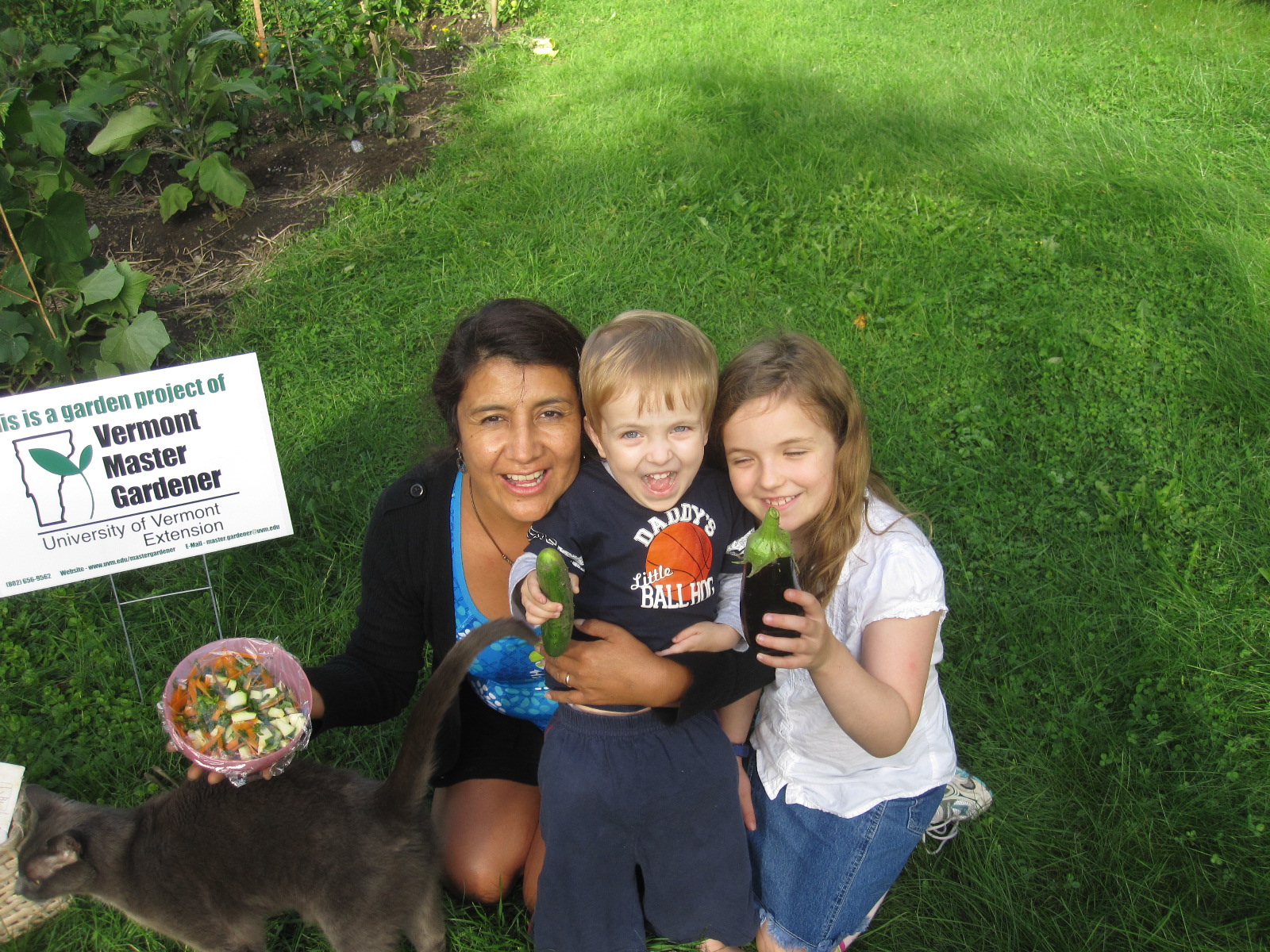
 Here I am with Isaiah and Chelsea showing off the harvest, and a kitty, their pet is posing with us.

Monday, August 22, 2011

Oh, Nooo!! What Are They?


Gardening should have always a permanent surveillance. If gardeners don’t monitor the garden constantly. After I checked the place, the soil looked good, weeds almost gone, no signs of early blight in tomatoes, nor the mildew powder in zucchinis. Life in the garden looked almost perfect -- until I noticed that some of the tomato leaves were suddenly blighted. This was an alert!  
 We found seven awful tomato hornworms...picking them off was an uncomfortable experience.

We were delighted with the previous rain. As usual, we stopped and checked the chopped tomato leaves, suddenly I touched something that looked as a pickled cucumber with a thicker bumpy skin growing as if this were part of the tomato plant! Imagine a texture like that on a tomato. Absolute nonsense!  It was a hornworm. Its size was about 3 1/2 to 4 inches (7-10cm) – I had never seen one since I started to grow vegetables and flowers in this country back in 2007.

Knowing About the Tomato Hormworm Tomato Hornworms are the larva of a huge moth called five-spotted hawkmoth. Approximate size of the moth is around the size of a hummingbird. It is gray-brown with yellow spots on the sides of their body.

Hornworm Lifecycle
The five-spotted hawkmoths lay their eggs as soon as they mate after hatching. They appear in late June to August. Full grown larva (3-4 weeks feeding) wander around the garden digging themselves in where they form a pupa (brown and about 3cm long) that overwinters and hatches in the spring.


How To Control Tomato Hornworms
  1. Use a liquid Bt (Bacillus thuringiensis) does not harm animals, people or the environment. It paralyzes the horn worms and they die from starvation. Spray the top and bottom of the tomato plant leaves. 
  2. Spraying the undersides of the leaves with an insecticidal soap mixture kills the eggs at the first sign of seeing the moths. 
  3. Parasitc Wasps (Braconid and Trichogramma) lay their eggs on the larva. If you see little white things on the worm don’t kill the worm, place it in a jar with a fresh leaf and keep feeding it until the wasps do their job. These are the cocoons of the wasp and their larva feed inside the host and will kill it. 
  4. Hand Pick. Tomato Hornworms are so big you cannot miss these guys.
  5. Companion Planting. Plant marigolds as a deterrent around or between your tomatoes. Marigolds stink to a lot of different bugs and they avoid them.
Hand picking and Bt spray have been applied to the garden!